
How Google Maps Top 3 rankings work in Australia
What the map pack is, how Google ranks local businesses in Australia, and what it takes to reach the Top 3 on Google Maps.
- Author
- BizGrow Digital · Local SEO team
- Published
- Updated
- Read time
- 7 min
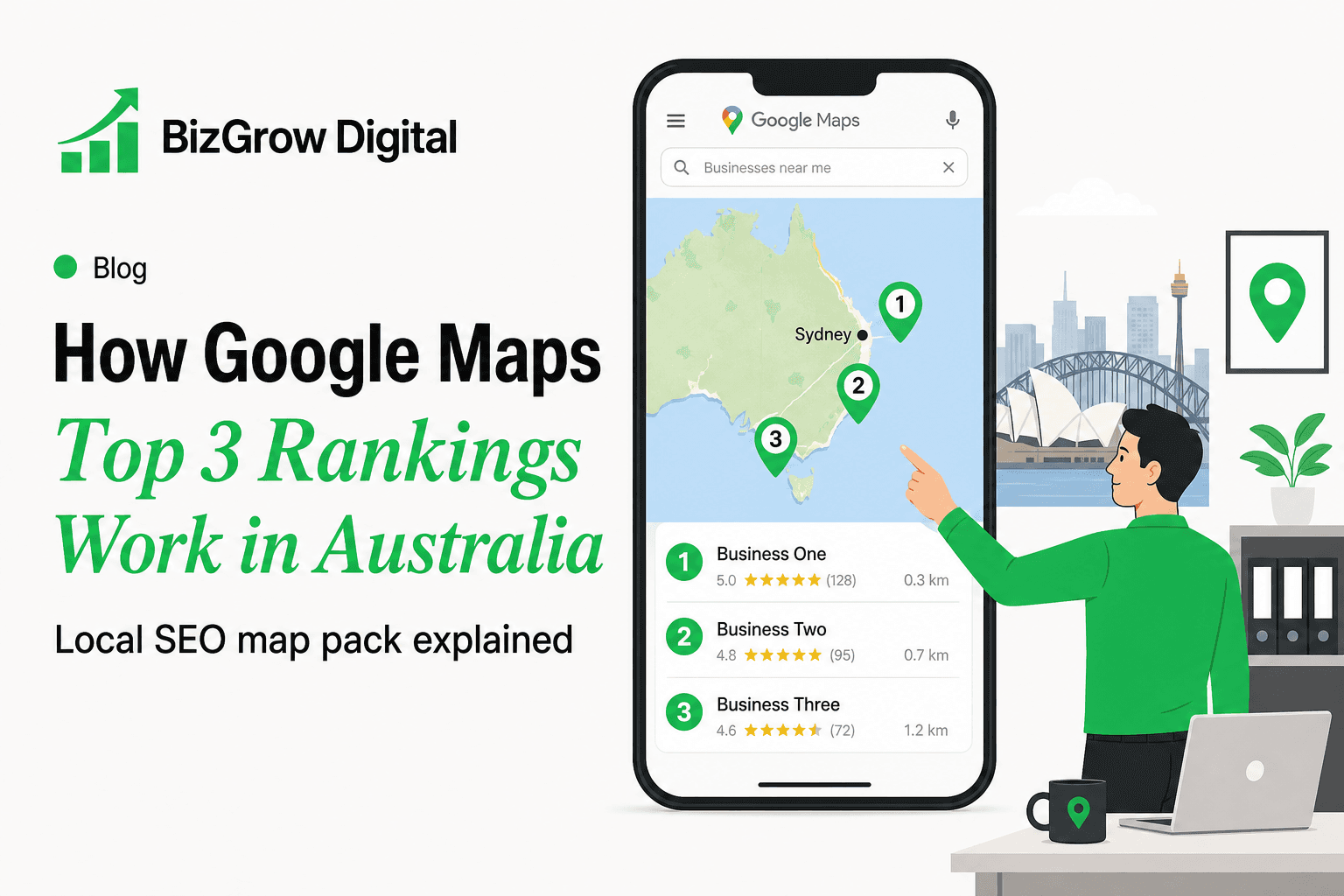
The Top 3 on Google Maps — also called the map pack or local pack — are the three business listings Google shows with a map when someone searches for a local service. In Australia, those three spots capture the majority of clicks from local searches. If you are not in the pack, most searchers never see you.
What is the Google Maps Top 3?
When you search on mobile or desktop for something like "plumber Killara" or "dentist near me", Google often shows a map with three businesses listed beneath it. Those are organic local results — not ads. Position 1, 2, and 3 in that block are what we mean by Top 3.
Below the map pack, Google shows more organic results and sometimes paid ads. The map pack sits above almost everything else, which is why ranking there matters more than being on page two of standard search results.
How does Google decide who ranks in the map pack?
Google uses three core factors for local rankings: relevance, distance, and prominence. Relevance is how well your Google Business Profile matches the search. Distance is how close you are to the searcher (or the location they specify). Prominence is how well-known and trusted your business appears online.
Relevance
Google reads your business name, categories, services, description, and website to understand what you offer. A complete, accurate profile that uses the terms customers actually search for ranks better than a bare-bones listing.
Distance
For "near me" searches, proximity matters. You cannot fake a Sydney CBD address if you serve Killara — but you can rank strongly in your actual service area by building location signals (suburb mentions, local citations, area-specific content) across your web presence.
Prominence
Prominence comes from reviews, backlinks, mentions on other sites, and overall brand signals. Businesses with more genuine reviews, consistent NAP (name, address, phone) across directories, and quality local links tend to outrank competitors with weaker authority.
How is the map pack different in Australia?
Australian local search behaves like other markets, but competition varies sharply by suburb and trade. Sydney's North Shore, inner city, and Western Sydney each have different competitor density. A keyword that is easy in one suburb can be fiercely contested in another.
- Mobile search dominates — most local queries happen on phones.
- Google Business Profile is the primary lever; your website supports it but does not replace it.
- Reviews matter — volume, recency, and responses all influence prominence.
- Suburb-level competition means generic national SEO tactics often underperform.
What does it take to reach the Top 3?
There is no single trick. Sustainable map pack rankings come from optimising your Google Business Profile, building citations on quality Australian directories, earning relevant backlinks, collecting genuine reviews, and aligning your website with your target locations and services.
At BizGrow Digital, we work to a 90-day target for Top 3 placement on guaranteed plans. Most clients see movement within two weeks because we focus on the highest-impact local signals first — profile optimisation, competitor gap analysis, and location-specific strategy rather than generic content churn.
How long does Top 3 take?
Timelines depend on your starting position, suburb competition, and profile health. Low-competition suburbs can move faster; contested trades in dense areas take longer. A realistic working window is 60–90 days for meaningful map pack movement when the fundamentals are executed consistently.